
FAQ
Have Questions?
Some questions and answers about electric vehicle charging
Choosing the right charger for your electric vehicle (EV) depends on two main factors: your car’s connector type and the type of charging you want.
Connector Types
There are several connector standards, but in Europe, the most common are:
Type 2 (Mennekes): This is the European standard for alternating current (AC) charging. Most new electric vehicles sold in Europe use this connector for slow and semi-fast charging. You’ll find this plug on many home chargers (wallboxes) and public charging stations.
CCS (Combined Charging System): This is an evolution of Type 2, adding two extra pins at the bottom to allow for fast direct current (DC) charging. It is the standard for fast and ultra-fast charging in Europe, making it compatible with most modern electric vehicles.
CHAdeMO: A DC fast charging standard, most common in cars from Japanese manufacturers (such as Nissan). Although it is gradually being replaced by CCS in Europe, it is still found at many fast charging stations.
To find out which connector your car uses, you can consult your vehicle’s manual or check the plug on the charging port.
Charging Types
Besides the connector, the choice of charger also depends on the charging speed you need.
Slow Charging (AC): This is usually done at home with a conventional outlet or a low-power wallbox. It is ideal for charging overnight when the car has been parked for long hours.
Semi-Fast Charging (AC): This uses a more powerful wallbox or public charging stations. It is a great option for charging your car in a few hours at home or at work.
Fast and Ultra-Fast Charging (DC): This is available at specific public charging stations and allows you to charge a large portion of the battery in just 20 to 30 minutes. It is the ideal solution for long trips.
The most important thing is to have a wallbox at home that’s compatible with your car’s connector, so you can charge your vehicle safely, quickly, and efficiently.
- It’s entirely possible to install an electric vehicle charger at home, whether in a house or condominium, or at your business. In fact, it’s the most convenient and economical way to charge your vehicle.
Installation at home or condominium
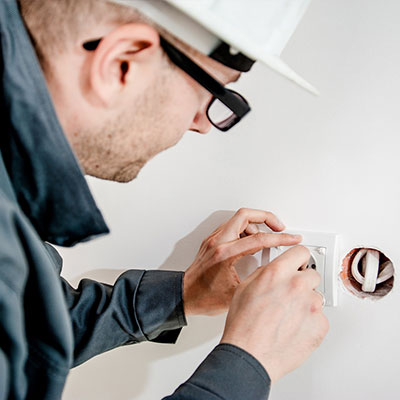
At home: installation is simpler. The decision is yours, and you only need to hire a certified electrician with specific training to install the wallbox. They will verify that your home’s contracted power is sufficient for the charger and other consumption, ensuring the safety and proper functioning of the entire system.
At condominium: Portuguese legislation simplifies the process. The law allows any owner to install a charger in their parking space. You simply need to notify the condominium management in writing. Installation costs and energy consumption are your sole responsibility.
Installation at businesses
Installing chargers at businesses is an excellent way to offer a benefit to employees and customers, in addition to promoting sustainability. The solution can range from individual chargers for the company’s fleet to the installation of a wider charging network for public or customer use. Ambiene can help you find and install the best solution for your business.
Which power should I choose?
Choosing the ideal power depends on your habits and the available electrical infrastructure:
3.7 kW (single-phase): ideal for those who park their car overnight. It’s enough to fully and efficiently charge the battery.
7.4 kW (single-phase): A faster option, perfect for those who need to charge their car faster.
11 kW to 22 kW (three-phase): For those who drive many kilometers daily, have fleets of vehicles, or want the fastest possible charging speed. This is the ideal option for three-phase electrical panels, to maintain their balance. It requires higher contracted power and adequate electrical installation.
The most important thing to keep in mind is that the charger’s power should not exceed the available charging power. Therefore, the best way to make an informed decision is to consult a specialist, who can assess your situation and recommend the right solution for you.
It’s a common myth that charging an electric car every day “degrades” the battery, just like old cell phones. The truth is that electric vehicle battery technology (lithium-ion batteries) is much more advanced and designed to be charged frequently.
Does charging every day degrade the battery?
No. You can charge your electric vehicle daily without any problems. In fact, most manufacturers recommend keeping the battery charge level between 20% and 80% to optimize its longevity.
Your car’s battery management system (BMS) is extremely intelligent. It constantly monitors the battery’s health, controlling temperature, voltage (volts), and energy flow (amps) to prevent any damage. Charging your car overnight with a lower-wattage charger is the ideal way to keep the battery in optimal condition.
The Impact of Fast Charging
Fast charging (direct current, or DC) uses very high power to charge the battery in a short period of time. This process generates more heat and greater stress on the battery components.
While fast charging is safe and doesn’t cause immediate damage, using it excessively and regularly can, in the long run, impact the battery’s overall longevity. Battery degradation is a natural process, but constant use of fast charging can accelerate it slightly.
In summary:
Daily charging: perfect and recommended. Charge your car whenever convenient, preferably overnight.
Fast charging: use it when truly necessary, such as on long trips or in emergencies, rather than as your primary charging routine.
Most manufacturers offer long battery warranties, often lasting 8 years or 160,000 km, ensuring peace of mind for owners. The most important thing is to use the charging method that best suits your routine and follow your vehicle manufacturer’s recommendations.
The range and charging time of an electric vehicle (EV) are the main concerns for those considering switching to electric mobility. The good news is that both issues have improved significantly with technological advancements.
Range: how many kilometers can I drive?
The range of an electric vehicle varies depending on the model, but today, most electric vehicles on the market offer very satisfactory ranges.
Compact models (urban use): These generally offer between 150 and 250 km of range. They are perfect for everyday city driving, commuting, or short trips.
Mid-range models (combined use): These can reach 300 to 450 km. They are ideal for everyday driving, weekend getaways, and even longer trips.
Top-of-the-line models (long trips): Range can exceed 500 km on a single charge.
It’s important to remember that actual range may vary depending on your driving style, route topography, air conditioning/heating usage, and outside temperature. Just like with combustion-engine cars, more efficient driving will take you further.
Charging time: how long does it take?
Charging time depends mainly on two factors: your car’s battery capacity and the power of the charger you’re using.
Slow charging (at home, with a conventional outlet): this takes longer. It can take 8 to 15 hours for a full charge, depending on the battery. It’s the most convenient way to charge overnight.
Semi-fast charging (at home, with a wallbox): This is the ideal solution. Using a 7.4 kW wallbox, for example, your car can be fully charged in 4 to 8 hours.
Fast charging (public charging stations): This is the option for road trips. A 50 kW charger can charge 80% of your battery in 30 to 60 minutes. For ultra-fast chargers, the time may be shorter.
Most people charge their cars at home overnight and only use fast charging on long trips, which makes managing range very simple and practical.
The cost of charging an electric vehicle (EV) is one of the biggest advantages of electric mobility. The big difference is where you choose to charge.
Cost of Charging at Home
Charging at home is the most economical way. The cost per kWh depends on your energy provider and the rate plan you choose. Most EV drivers opt for plans with bi-hourly rates, which offer a lower price at night, the “off-peak” time.
Average Cost: in Portugal, the cost per kWh can vary, but on average, charging at home at night costs between €0.10 and €0.15 per kWh.
Practical Calculation: A 60 kWh battery would cost between €6 and €9 for a full charge, which can give you around 300 to 400 km of range, depending on the car model.
Cost of Charging at Public Stations
Public charging stations are more expensive, but they are also faster and more convenient for long trips. The cost varies depending on the charging network and the station’s power (semi-fast, fast, or ultra-fast).
Slow/semi-fast (AC) charging stations: These cost around €0.20 to €0.35 per kWh.
Fast (DC) charging stations: These have a higher price, between €0.40 and €0.60 per kWh.
Compensation Compared to Traditional Fuels
Despite rising electricity prices, charging an EV remains significantly cheaper than refueling a gasoline or diesel car.
For example: at current average prices, a Diesel car that consumes 6 liters per 100 km costs around €10 to €12 to travel 100 km.
With an EV: the cost for the same 100 km, charging at home overnight, is approximately €2 to €3.
The difference is noticeable. In addition to the lower energy costs, electric vehicles are simpler and cheaper to maintain, which makes the savings even greater in the long run. The higher initial investment of an EV is quickly offset by the much lower operating costs.
The availability of the public charging network in Portugal has grown significantly in recent years, becoming increasingly reliable in both urban areas and on highways.
Public Network Availability
The national electric mobility network (Mobi.E) is the main infrastructure in Portugal, with over 13,000 charging points throughout the country, including in the Azores and Madeira. Expansion continues at a rapid pace, with an average of 26 new stations installed per week. With recent legislative changes, an even greater expansion of the public network is already being observed.
On highways, coverage is also quite solid. Major roads, such as the A1 (Lisbon-Porto) and A2 (Lisbon-Algarve), already have a network of fast and ultra-fast chargers in several service areas, allowing you to travel from north to south of the country without range anxiety.
How to find charging stations?
Finding a charging station is very simple and can be done through mobile apps or dedicated websites. The most popular and recommended are:
Mobi.E: The official website and app of the national network. They allow you to view the location, plug type, power, and real-time availability of charging stations.
Google Maps: Already integrated, it allows you to search for “charging stations” to find nearby locations, check the plug type, and see reviews from other users.
Electromaps: A very popular app that works in Portugal and Spain, showing the location of thousands of stations, including those from private networks, and offering detailed information and community reviews.
Other apps: Many energy and automotive companies also have their own apps, such as Galp Electric or Via Verde Electric, which can be used to find and pay for charging.
Request a Quote Today
Reach Us
Location :
Av. Major Botelho Moniz
170 – bl. 2, 1º dir.
4405-661 VN Gaia
Email :
mail@ambiene.pt
Phone :
+351 229023030
+351 966985849